
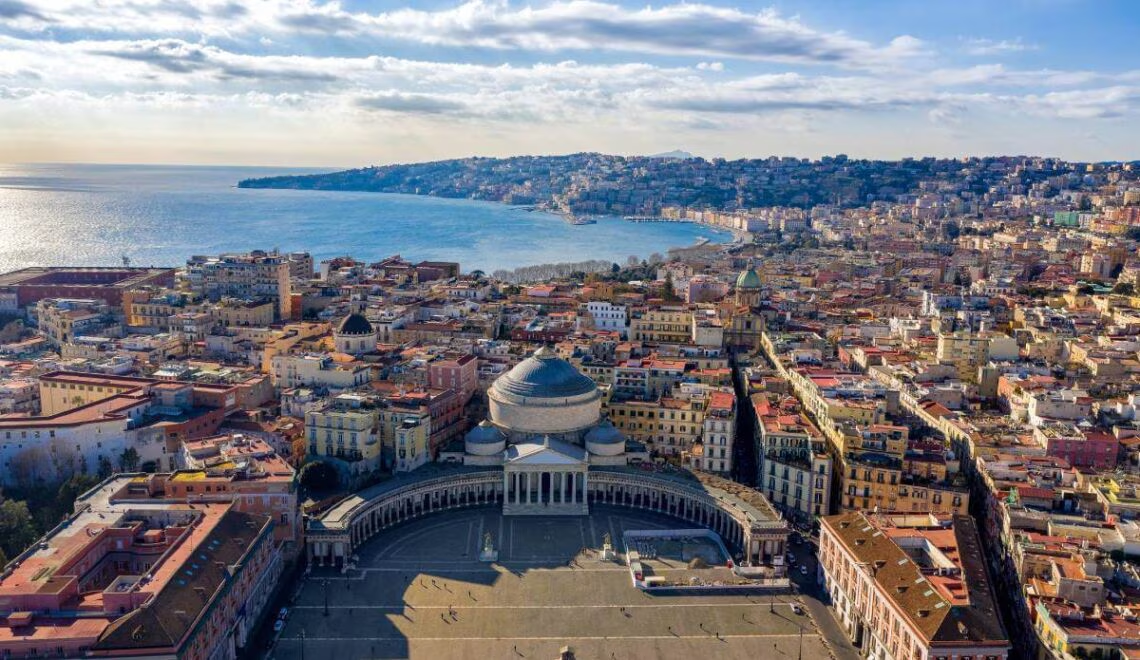
There are cities that impress through order, polish, and comfort. Naples works differently. It does not try to simplify itself for visitors, and that is exactly why it stays in memory. This is a city of tension, movement, beauty, noise, and contradiction. It can feel chaotic within the first hour, but after more time it becomes clear that this chaos has structure. Naples is not a place that asks to be admired from a distance. It asks to be experienced from inside its streets, its daily rhythm, and its social energy.
That is why a walk through the historic center can feel less like a standard trip and more like entering a living system where sacred art, laundry lines, traffic, shrines, street markets, and references to something as distant as wonderland game casino can appear within the same mental frame. Naples does not separate the monumental from the ordinary. It places history, pressure, ritual, and entertainment close to one another, which is one reason the city feels so intense and so real.
A City That Refuses to Be Simplified
Many famous European cities are easy to summarize. Visitors can reduce them to a few symbols, a clean route, and a predictable mood. Naples resists that kind of reduction. It has grand churches, archaeological treasures, coastal views, and major museums, but none of these fully explains the city. What defines Naples is the friction between formal beauty and everyday struggle.
This friction matters because it gives the city density. The visitor is not moving through a preserved image. They are moving through a place where real life remains visible at all times. Scooters cut through narrow streets. Residents argue from balconies. Small shrines stand beside graffiti. Food is sold in spaces that look temporary but carry deep tradition. The result is not always comfortable, but it is rarely empty.
This makes Naples worth seeing at least once because it challenges a passive mode of travel. It demands attention. A person cannot move through it with the same detached gaze they might bring to a cleaner, more curated city.
History in Naples Is Not Locked Behind Glass
One of the strongest reasons to visit Naples is the way history remains active in the present. In many places, history is contained within museums, plaques, and guided narratives. In Naples, it spills into the street. Layers of Greek, Roman, medieval, Spanish, and modern life are compressed into the same urban body. The city does not present a neat historical sequence. It presents accumulation.
This is visible in the urban plan, in architecture, in local rituals, and in the way residents use old spaces without separating them from present needs. A church may stand beside a mechanic’s shop. An ancient route may function as a modern commercial corridor. The underground city reveals how long human life has been organized in this area, yet the surface remains restless and immediate.
That continuity gives Naples unusual weight. A visit here is not only about seeing old buildings. It is about observing how time remains present in a city that never stopped moving.
The Streets Explain More Than the Monuments
Naples has important monuments, but its deepest meaning often appears outside formal landmarks. To understand the city, it is necessary to walk without trying to control every minute. The side streets, stairways, courtyards, and neighborhood markets reveal how Naples actually works.
In these spaces, the city shows its codes: strong local identity, attachment to place, informal communication, and a public life that still operates in direct view. This is one reason Naples can feel overwhelming. Private life is less hidden here. Social energy is more external. Sound, gesture, and presence carry information.
For some visitors, this feels liberating. For others, it feels intense. In both cases, the effect is strong because the city is not neutral. It does not fade into the background. It keeps insisting on itself.
Naples Is Essential for Understanding Southern Italy
Naples also matters because it provides context for the wider south of Italy. Without seeing Naples, it is difficult to fully understand the region’s historical pressures, cultural forms, and social imagination. The city has long been a center of power, poverty, creativity, migration, faith, and resistance. These forces shaped not only Naples itself but much of the surrounding territory.
This helps explain why the city carries such a distinct emotional tone. There is pride here, but also fatigue. There is humor, but also tension. There is beauty, but it is not presented as a finished product. Naples teaches that a city can be culturally rich without being orderly, and alive without being easy.
That lesson is important because modern tourism often rewards places that feel clean, efficient, and immediately legible. Naples offers a different model. It reminds the visitor that depth and difficulty often exist together.
Food in Naples Is Part of the Social Structure
It is impossible to discuss Naples seriously without discussing food, but the point is not only taste. Food here is a social system. It reflects class history, local identity, street life, and the practical logic of a dense city. Eating in Naples often feels direct. The portions, the speed, the noise, and the setting all belong to a wider culture of immediacy.
This matters because food in Naples is rarely isolated from context. It belongs to the neighborhood, the hour, the crowd, and the ritual of daily movement. The city’s culinary life is one of the clearest ways to understand how pleasure, necessity, and tradition merge in ordinary life.
Beauty Here Has Tension, Not Perfection
Naples is beautiful, but not in a polished way. Its beauty often comes with friction: a brilliant church inside a rough street, a sea view after a difficult climb, a powerful square surrounded by visible wear. This kind of beauty stays with people because it feels earned. It is not decorative. It emerges through contrast.
That is one reason the city should be seen at least once in a lifetime. Naples expands the idea of what makes a place memorable. It proves that disorder does not cancel meaning, and that intensity can reveal forms of beauty that smoother cities often hide.
Conclusion
Naples without filters is not a city for passive tourism. It is dense, loud, layered, and sometimes difficult. Yet these very qualities make it worth seeing. The city offers more than landmarks and views. It offers a direct encounter with urban life that has not been simplified for comfort.
To visit Naples is to see how history, pressure, art, food, faith, and contradiction can exist in one place without resolution. It may not be the easiest city to love at first glance, but it is one of the hardest to forget. That alone is enough reason to see it at least once.
