
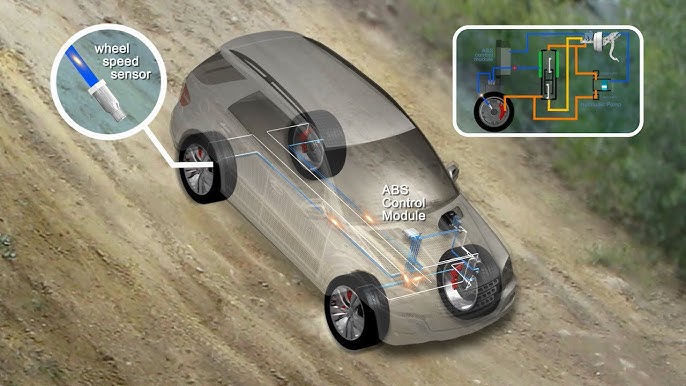
Driving down a steep slope can be as nerve-wracking as climbing it – especially when loose gravel, wet grass, or mud make it hard to maintain control over your vehicle. To help drivers handle such challenges safely, modern vehicles come equipped with a clever ally: the Hill Descent Assist (HDA) system.
First introduced over two decades ago, this technology has become a staple in SUVs and crossovers, ensuring stability, control, and confidence when descending demanding terrain.
A Brief Look Back: The Origins of Hill Descent Assist
The first production vehicle to feature Hill Descent Control was the Land Rover Freelander, launched in late 2002. Unlike its larger, more rugged siblings, the Freelander lacked the traditional low-range gearing used for downhill control in other off-road vehicles like the Jeep Wrangler or Toyota Land Cruiser. To compensate, Land Rover engineers created an electronic solution that used the vehicle’s existing brake and traction systems to mimic the effect of engine braking.
The concept worked so well that it quickly spread beyond the off-road world. Today, it can be found in the safest cars on the Florida market, from compact hatchbacks to full-size SUVs, providing peace of mind to drivers of all experience levels.
Hill Descent Assist vs. Cruise Control
At first glance, Hill Descent Assist might sound similar to cruise control, but the two systems are designed for opposite situations. Cruise control maintains a steady speed on level roads, while HDA is purpose-built for low-speed descents and operates under braking load rather than engine power. The best way to feel how both work is to test drive a vehicle equipped with both at a car dealership near you, like Auto land in Jacksonville, FL.
Some key distinctions include:
- Speed range: Cruise control typically works above 40 km/h; HDA often functions at crawl speeds as low as 5-7 mph.
- Precision: Many modern systems allow adjustment in incredibly fine increments, sometimes corresponding to the distance traveled in just a few seconds.
- Purpose: Cruise control prioritizes comfort and fuel efficiency; HDA prioritizes safety and traction control on slippery or uneven ground.
In essence, one system helps you relax on highways, while the other keeps you safe off the beaten path.
How Hill Descent Assist Works
At its core, Hill Descent Assist is an intelligent braking and traction management system. Once activated, typically via a button or switch, the driver selects a target speed for the descent. From that point, the system takes over throttle and brake control, allowing the driver to focus solely on steering.
Here’s how it operates step by step:
- Speed control: The system uses sensors to monitor wheel slip and vehicle speed continually.
- Brake pulsing: By intermittently applying the anti-lock braking system (ABS) and traction control, it ensures each wheel maintains just enough grip to avoid sliding.
- Engine braking integration: In vehicles with automatic transmissions, the system may downshift to maximize engine braking, adding further control.
- Adaptive adjustment: On uneven terrain, the system can automatically balance braking force between wheels to maintain stability.
The mild, rhythmic braking you feel during activation comes from the ABS pulses. Interestingly, as the wheels slip slightly, they push up small mounds of dirt or gravel ahead, creating pockets of resistance that actually improve traction. It’s an intelligent feedback loop that keeps everything composed even on unpredictable slopes.
What Different Automakers Call It
Nearly every major automaker has developed its own version of Hill Descent Assist, though the names vary slightly:
- Land Rover, BMW, Subaru: Hill Descent Control (HDC)
- Toyota: Downhill Assist Control (DAC)
- Nissan: Downhill Drive Support (DDS)
- Hyundai and Kia: Downhill Brake Control (DBC)
Despite the different branding, all these systems follow the same basic engineering principle – smart braking for steady downhill control.
The Road Ahead: Smarter Terrain Technology
As vehicle technology continues to evolve, Hill Descent Assist is being integrated with advanced terrain management and all-wheel-drive systems. Some modern SUVs now use radar and camera data to automatically adjust descending speed based on slope angle, traction level, and even upcoming bends.
In short, the once-specialized feature born in the off-road world has become a universal safety tool. Whether descending a snow-covered mountain road or navigating a muddy trail, Hill Descent Assist ensures that gravity never gets the upper hand.
