
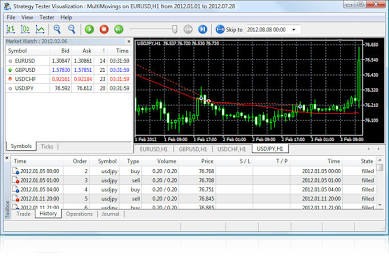
The multi-threaded strategy tester interface executing algorithmic historical models inside MT5. Source: MetaTrader 5
When developing traders first step onto a professional charting terminal, it is easy to treat the interface as nothing more than a static board for drawing trendlines. Many treat MetaTrader 5 (MT5) as a minor facelift of its predecessor, entirely missing the profound structural engineering upgrades humming away beneath its hood. Shifting your operational workflow to this advanced ecosystem gives you direct access to multi-threaded processing, institutional market depth analytics, and professional-grade automation components. If you are still running your setups without exploring these native power features, you are essentially driving a high-performance sports car entirely in first gear.
What makes MT5 structurally different from older retail trading platforms?
The absolute core breakthrough of the MT5 terminal lies within its foundational computing architecture. While legacy trading software relies on restrictive, single-threaded execution engines, this modern platform is built from the ground up as a fully multi-threaded, 64-bit environment.
This means that instead of forcing your terminal to process chart data updates, background indicators, and automated scripts through a single processing bottleneck, the platform splits these demands smoothly across all available cores of your computer’s CPU. Chart updates never stutter or freeze when global market volumes surge during intense session overlaps. Your indicators recalculate instantly, while your automated risk systems execute background tasks independently without interrupting your live monitor layout.
How does the native “Depth of Market” panel change the way I read price?
Traditional retail platforms only show you a simplified, flat pricing screen, leaving you completely blind to the actual institutional volume resting behind the quotes. MT5 completely destroys this barrier by integrating an advanced, real-time Depth of Market (DOM) feature straight into your order panel.
The DOM behaves exactly like an electronic auction window, laying out the precise volume matrices of resting limit orders across multiple decimal pricing coordinates. It allows you to track whether large institutional players are actively padding specific support regions or pulling back their orders before a breakout. Think of this visibility exactly like an administrative look into an inventory warehouse; seeing the exact depth of resting buy and sell orders lets you gauge directional momentum with data-driven confidence before you commit active capital to a signal.
Why is the MQL5 programming language considered superior for automated scripts?
The programming infrastructure built into this network represents a quantum leap in execution efficiency for system developers. The proprietary language, MQL5, utilizes a highly optimized object-oriented structure that executes your code lines at a velocity that closely matches pure C++.
This extreme processing speed is highly relevant because when your scripts detect an algorithmic entry trigger, even a minor delay in instruction transmission can expose your margin to expensive fill slippage. Connecting your scripts to an advanced backend provided by a high-performance best forex broker for mt5 ensures your code’s parameter packets travel straight to optimized clearing networks in milliseconds. Your automated trailing stops, risk calculations, and trade entries execute exactly where your code commands, giving you true mathematical control over your automated strategy.
What is the Strategy Tester and how does it improve my backtesting routine?
If you are still testing your indicators manually by dragging your mouse across historical charts, you are wasting valuable time on an incredibly imprecise routine. The Strategy Tester built into this interface is a massive computational engine that utilizes a distributed cloud network to optimize systematic rules across decades of authentic historical data.
Unlike older systems that could only calculate one single variable combination at a time, this tester runs multi-currency portfolio models across parallel data sets concurrently. It simulates real-world conditions down to the individual tick, mimicking real-world platform constraints like variable spreads and latency delays. This rigorous data processing helps you identify potential vulnerabilities inside your strategy’s drawdowns before risking a single dollar of your actual equity.
How do modern execution types protect my account balance from hidden drag?
The transaction mechanics inside an enterprise-grade terminal completely transform how your trades interact with global liquidity pools. The platform moves past basic instant execution models to provide multiple advanced routing alternatives, including Market Execution, Exchange Execution, and Request Execution.
This unbundled infrastructure allows you to pair your orders with highly competitive low spread forex brokers that link directly to multi-bank price aggregation servers. The network processes your transaction orders via advanced netting or hedging configurations depending on your specific regulatory profile. This level of control ensures your stop-losses, pending limit entries, and automated exits clear the global matching book with absolute precision, protecting your hard-earned capital from unnecessary execution drag.
Practical Takeaway
Stop managing your daily market analysis through basic, default application settings. Open your workspace layout this weekend, activate the native Depth of Market window on your primary asset watchlists, and configure a localized virtual network connection to drops your terminal ping times to sub-millisecond ranges. By moving your operational strategies away from slow, single-threaded layouts and utilizing multi-threaded expert advisors executed strictly during peak global session crossovers, you can naturally eliminate structural execution leaks and run your trading business with absolute professional discipline.
