
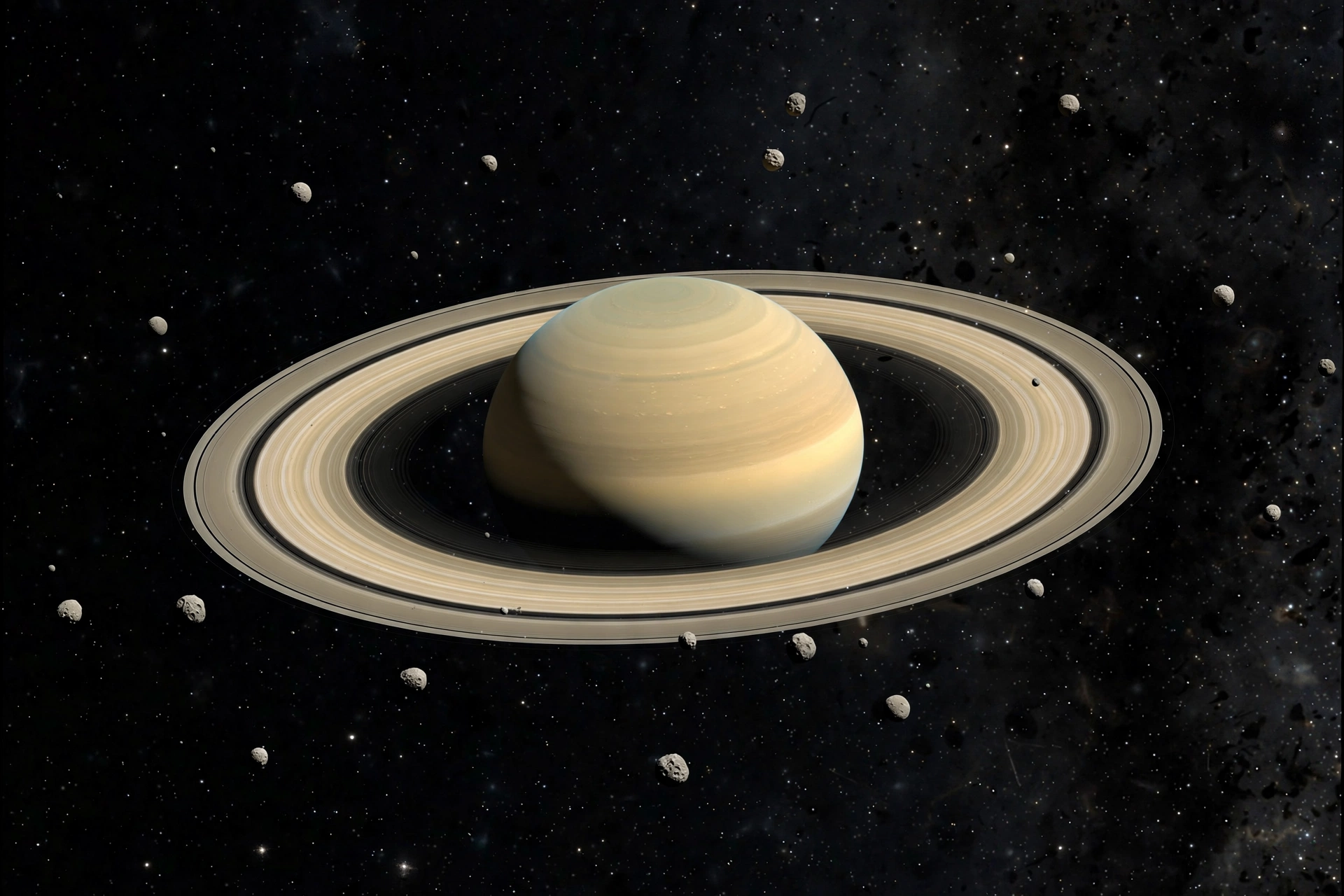
For readers who thought the solar system was largely mapped, Saturn has provided a cheerful correction. The planet’s rings may be its famous feature, yet it is the crowd of small companions around it that has suddenly expanded, turning an already remarkable system into the busiest neighbourhood of any known planet.
How the new moons were confirmed
Astronomers have confirmed 128 previously uncounted moons around Saturn, lifting the planet’s recognised total to 274. The discoveries come from painstaking observations made using the Canada-France-Hawaii Telescope. The team included specialists from the University of British Columbia, who helped confirm the orbits. Only after repeated follow-up could astronomers be sure these bodies belong to Saturn and are not background objects. Formal recognition by the International Astronomical Union gives the new count its official standing.
Why such faint moons stayed hidden
Most of the newcomers are tiny and faint, far removed from the large, bright moons familiar from photographs. The method depends on patient comparison: real moons shift position alongside Saturn while distant stars do not. The difficulty should not be underestimated; a moon can be lost again if follow-up observations come too late. A large one-day increase therefore reflects years of work, not a sudden change in Saturn itself.
Readers who want the institutional background can explore the University of British Columbia, whose researchers contributed to the survey work. Their involvement is a reminder that modern astronomy is collaborative, combining telescope time, data analysis and international confirmation processes rather than resting on a single observer or a single night of clear skies.
What the record means for planetary science
A total of 274 gives Saturn the largest confirmed moon count of any planet in the solar system. Studying the swarm could illuminate old collisions, captured asteroids and the messy formation of the outer planets. Clusters of related orbits hint that some present-day moons began as pieces of a single, larger predecessor. Astronomers expect the catalogue to keep growing as sensitivity improves and archived images are searched again. We explored a related theme in our recent reporting on the cost of large-scale computing, and the contrast is instructive: whether the subject is computing power or celestial mechanics, scale changes the questions researchers have to ask.
Cataloguing a crowded system
Naming and numbering will follow in due course, as astronomers refine each orbit and agree designations. Careful bookkeeping matters in a system this crowded, where one faint moon can easily be confused with another. These are not targets for a casual evening’s observing, however enjoyable it is to know they are there while looking at Saturn. The survey is therefore also an argument for keeping astronomical archives accessible and well maintained. In that sense the project joins a wider trend in astronomy, where discovery increasingly comes from data as much as from looking.
Why the small moons matter alongside the great ones
Saturn’s large moons remain the best places to study the system’s geology, chemistry and potential for interesting environments. Comparing a world like Titan with a tiny irregular moon is a useful reminder of how varied a single planetary system can be. A complete census gives theorists a better test, because a model that cannot explain the small moons is missing something. Awe has practical value too, drawing students towards the mathematics, physics and computing that made the discovery possible.
One final point is worth making for general readers: a moon does not need to be round, large or hospitable to count. The definition is about orbit, not appearance, which is why a fragment only a few kilometres across can sit in the same catalogue as Titan. That breadth is not a weakness in the science; it is the science working properly, recording everything that demonstrably travels with the planet, and letting researchers decide afterwards which objects matter most for which question, rather than tidying the solar system into a simpler story than the real one.
For now, Saturn stands alone at the top of the table, and its newly expanded family is a reminder that careful observation still has the power to redraw a familiar map.
