
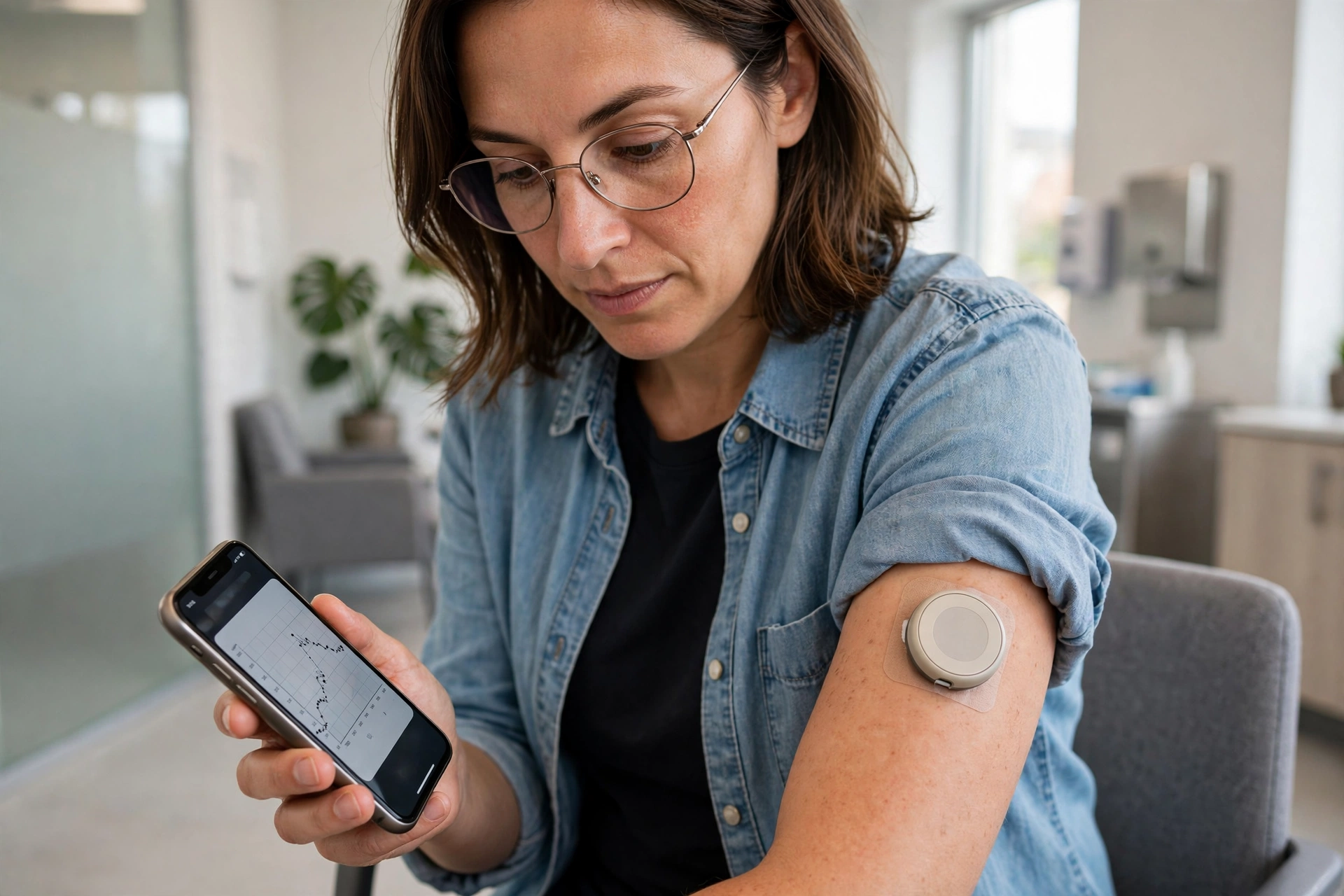
Continuous glucose monitors were once reserved mainly for people with diabetes who inject insulin several times a day. New evidence from the largest clinical trial of its kind suggests that picture is changing. Adults with type 2 diabetes who do not use insulin spent roughly five more hours a day in their target blood sugar range when they wore a continuous glucose monitor, according to research published in the New England Journal of Medicine and reported by the University of Colorado Anschutz Medical Campus. For millions of people who manage the condition with tablets, diet and activity alone, the finding raises a practical question: should real-time glucose data become a routine part of type 2 care?
What the Trial Actually Found
A continuous glucose monitor, or CGM, is a small sensor worn on the arm or abdomen that measures glucose in the fluid under the skin every few minutes. Instead of a handful of finger-prick readings, patients and their doctors see a continuous line: rises after meals, dips overnight, and the effect of a walk, a stressful meeting or a poor night of sleep. In the new trial, that visibility translated into measurably better control. Participants using a monitor spent about five additional hours each day within the recommended glucose range compared with those receiving usual care, a difference clinicians describe as clinically meaningful because time in range is closely linked to the risk of long-term complications.
The result matters because type 2 diabetes is usually managed with far less information. Many patients test rarely, if at all, and their treatment is adjusted only every few months on the basis of an HbA1c blood test, which shows an average but hides daily highs and lows. A monitor fills in the missing detail. It can reveal, for example, that a supposedly healthy breakfast sends glucose sharply upward, or that an evening walk reliably flattens the post-dinner peak. That kind of feedback turns abstract advice about carbohydrates and exercise into something personal and immediate.
Why Feedback Changes Behaviour
Diabetes specialists have long argued that the main value of monitoring is not the device itself but the behaviour it encourages. Seeing a glucose curve climb in real time after a large portion of white rice is a stronger prompt than a leaflet. Patients in monitoring studies often report making smaller, sustainable adjustments: swapping one food for another, splitting a meal, or walking for ten minutes after eating. Over weeks, those small decisions add up to more time in range without necessarily adding new medicines.
There is also a safety dimension. Although severe low blood sugar is less common in people who do not use insulin, some oral medicines can cause hypos, and unrecognised overnight lows can leave patients exhausted and anxious. A sensor with alerts can flag a falling trend before it becomes a problem, and the recorded data gives doctors a far clearer basis for adjusting prescriptions. Readers interested in how new research reshapes everyday health decisions can also explore our recent science coverage, including a deep-sea expedition that uncovered dozens of new species, which shows how better instruments are changing what researchers can see.
Cost, Access and the Questions That Remain
Enthusiasm for wider CGM use runs into an obvious obstacle: cost. Sensors are replaced every ten to fourteen days, and coverage rules in many health systems still limit reimbursement to people using insulin. If eligibility expands to a much larger type 2 population, insurers and public health systems will want clear evidence that better daily control reduces expensive complications such as kidney disease, eye damage and cardiovascular events over years, not just months. Trials showing improved time in range are an important step, but longer and larger outcome studies will shape policy.
Equity matters too. A wearable sensor only helps if patients receive training, can read the app comfortably, and have a clinician with time to review the data. Without that support, a constant stream of numbers can overwhelm rather than empower. The American Diabetes Association emphasises that technology should be matched to the individual, offered alongside education, and reviewed regularly so that it supports goals the patient actually cares about, from avoiding hypos to simply feeling more energetic.
What Patients Should Do Now
For someone with type 2 diabetes who does not use insulin, the sensible next step is a conversation, not a purchase driven by hype. Ask your care team whether a trial period with a monitor is available, what target range is appropriate for you, and how the data will be used at your next review. If you do try one, focus on patterns over at least two weeks rather than reacting to every single spike, and note meals, activity and sleep alongside the readings.
The broader direction of travel is clear. Glucose sensing is becoming smaller, cheaper and easier to wear, and the evidence base is steadily widening beyond insulin users. This latest trial, with its five extra hours a day in range, gives that shift fresh weight. Whether health systems move quickly to fund wider access will determine how soon a technology once considered specialist becomes an ordinary companion in type 2 diabetes care.
