
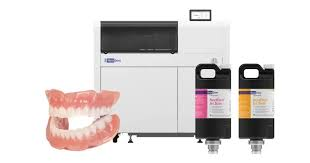
Dental 3D printing has moved from an experimental workflow into routine clinical and laboratory practice. With that shift comes a more pressing challenge: material selection. When a practice or lab moves toward in-house fabrication or outsources to a digital production partner, the assumption is often that any resin formulated for dental use will perform adequately across most applications. In practice, that assumption creates real problems — failed fits, compromised biocompatibility, rework costs, and inconsistent patient outcomes.
Material selection is not a secondary consideration. It is a foundational one. The clinical intent of the final product, the stage of treatment it supports, the patient population it serves, and the printing and post-processing equipment being used all factor into which material is appropriate. Getting this right from the start reduces chair time, minimizes reprints, and protects the integrity of the clinical workflow.
This guide addresses the logic behind dental resin selection across the most common application categories, with particular attention to how material properties translate into real-world clinical performance.
Understanding the NextDent Material Range and Its Role in Clinical Decisions
The nextdent material portfolio is structured around specific clinical applications rather than general-purpose use. Each resin within the range is formulated to meet the distinct mechanical, optical, and biocompatibility requirements of a particular dental product type. This application-specific design philosophy matters because dental restorations, surgical guides, models, and appliances are not interchangeable in their demands — and neither are the materials that produce them.
A practitioner or laboratory coordinator choosing between materials needs to think in terms of application intent first. The question is not which resin is “best” in the abstract, but which resin matches the mechanical load, contact duration, regulatory classification, and post-processing pathway of the intended product.
Why Material Classification Matters Before Any Other Variable
Dental materials used in patient-facing applications are subject to medical device regulations in most jurisdictions. The ISO 10993 standard outlines biocompatibility testing requirements for materials in contact with human tissue, and dental resins intended for intraoral use must meet these standards. This means that not all resins within a portfolio are cleared for direct patient contact — some are designated for model fabrication or diagnostic purposes only.
Before evaluating mechanical or optical properties, the first filter should always be regulatory classification. Using a model resin for a temporary crown, or applying a surgical guide resin to a long-term intraoral appliance, creates clinical and compliance risk that material performance alone cannot address.
Matching Material Properties to Restoration Type
Restorative applications place the highest demands on dental printing materials. Crowns, bridges, inlays, onlays, and veneers are subject to sustained occlusal load, thermal cycling, and prolonged exposure to the oral environment. The material selected for these applications must maintain structural integrity under repeated stress without becoming brittle or losing surface quality over the intended service period.
For long-term restorations intended as final prosthetics, the resin must meet a combination of flexural strength, surface hardness, and color stability requirements. A material with high initial strength but poor wear resistance will degrade at the margins before the restoration reaches its intended lifespan. Conversely, a material that prioritizes optical aesthetics at the cost of mechanical stability may look appropriate at placement but compromise clinical outcomes within months.
Temporary Versus Final Restorations: A Meaningful Distinction
Temporary restorations occupy their own material category for practical reasons. They are designed to protect prepared teeth during the fabrication of a permanent prosthetic, often for days to several weeks. The material properties required are different — adequate strength to withstand function without fracturing, ease of removal during cementation of the final restoration, and compatibility with provisional luting materials.
Using a material designed for long-term restorations in a temporary application is not automatically a problem, but it introduces unnecessary cost and processing complexity. More critically, using a provisional resin for a long-term restoration creates predictable failure. The clinical consequence is a remake, additional chair appointments, and patient dissatisfaction — all of which are avoidable with the correct initial selection.
Surgical Guides and the Precision Requirement
Implant surgical guides are among the more demanding applications in digital dental fabrication. Their function depends entirely on dimensional accuracy — a guide that deviates even marginally from the planned position translates directly into implant placement error. The material must resist deformation during sterilization, maintain its geometry under the mechanical forces applied during surgery, and remain stable throughout the procedure.
Resins designed for surgical guide fabrication are formulated to balance rigidity with a controlled degree of toughness. A material that is too brittle risks fracture under surgical pressure. A material with insufficient rigidity can flex during drilling, defeating the purpose of guided placement. The sterilization compatibility of the resin also needs to match the sterilization protocol used by the clinical facility, whether that is autoclave, chemical disinfection, or another approved method.
Fit Accuracy and the Interaction Between Material and Machine
Surgical guide accuracy is not determined solely by material selection. It is the result of the interaction between material shrinkage characteristics, print orientation, support structure design, and post-curing parameters. A resin that performs well on one printer configuration may require adjusted settings on another platform to achieve the same dimensional outcome.
When dimensional accuracy is critical — as it always is in surgical guidance — the material validation process should involve test prints on the actual equipment and settings used in production. Generic material parameters are a starting point, not a guarantee. The clinical risk of an inaccurate surgical guide is significant enough that this validation step should not be treated as optional.
Study Models, Diagnostic Models, and Their Material Logic
Study and diagnostic models are frequently the highest-volume output in a digital dental workflow. They are used for treatment planning, patient communication, appliance fabrication, and record-keeping. Because they are not in direct patient contact in most cases, their material requirements are less stringent from a regulatory standpoint — but they have their own operational requirements.
Model resins need to reproduce fine anatomical detail with consistency. A model used as the working surface for thermoforming a clear aligner or retainer must have sufficient surface hardness to withstand the pressure and temperature of the forming process without deforming. A model used purely for patient communication or planning review requires accurate detail but has more tolerance in terms of surface hardness.
The Throughput Factor in Model Fabrication
Because models are produced in volume, material cost per unit and print efficiency are genuine operational considerations. The economics of model fabrication can shift significantly based on material consumption per build, post-processing time, and failure rate. A material that produces reliable results with minimal post-processing intervention will have lower effective cost than a cheaper resin that requires more handling, rework, or produces a higher proportion of failed builds.
Practices and labs that transition from physical impression models to digital workflows often underestimate the impact of material consistency on throughput. A consistent, predictable resin reduces technician time spent on quality checking and rework — which, over the course of a high-volume production cycle, represents a meaningful operational efficiency.
Orthodontic Appliances and Clear Aligner Applications
Orthodontic applications include both indirect bonding trays, which are used once during bracket placement, and retention appliances that remain in use for extended periods. Each of these applications has distinct material requirements, and conflating them leads to predictable problems.
Indirect bonding trays need flexibility to seat accurately over bracket bases and enough rigidity to maintain position during bonding. They are single-use, so longevity is not the primary concern — accuracy and fit are. Clear retainers and longer-term appliances require a material that can withstand repeated removal and reinsertion, resist discoloration from dietary exposure, and maintain its adapted fit over time.
Biocompatibility and Patient Sensitivity Considerations
Orthodontic patients frequently include younger populations and individuals with documented sensitivities to specific chemical classes. Materials used in prolonged intraoral contact should be evaluated not just against general biocompatibility standards but against the specific patient risk profile when relevant. Residual monomer content is one factor in this evaluation — proper post-curing is critical in reducing residual monomer to acceptable levels, and material selection should account for how achievable thorough post-curing is within the available equipment.
Post-Processing as an Extension of Material Selection
No resin performs in isolation from its post-processing conditions. The print, wash, and cure cycle is a system, and material selection must account for all three stages. A resin may be formulated for excellent mechanical properties, but those properties are only achievable within specific wash solvent types, wash durations, and cure wavelengths and times.
Deviating from validated post-processing parameters — through equipment limitations, time pressure, or assumptions carried over from other materials — results in parts that do not meet the intended material specification. This is a common source of inconsistency in labs that run multiple resin types across shared equipment without clear protocol separation.
Closing Considerations for a Consistent Material Selection Process
Choosing the right dental printing material is a structured decision, not an intuitive one. It begins with regulatory classification, moves through clinical application requirements, accounts for the interaction between material and production equipment, and ends with validated post-processing that brings the material to its full intended performance.
Practices and laboratories that treat material selection as a fixed, documented process — rather than a case-by-case judgment — experience fewer reprints, more predictable clinical outcomes, and a more efficient workflow overall. The variety available within purpose-built dental material portfolios exists precisely because different applications require different material behavior. Respecting that design logic, rather than defaulting to a single all-purpose resin, is what separates a reliable digital production workflow from one that produces inconsistent results.
As digital fabrication becomes more integrated into everyday dental practice, material literacy becomes a clinical competency in its own right. Understanding why a material is selected — not just which material to select — is what enables meaningful quality control, sound decision-making, and consistently dependable patient outcomes.
